Field Guide · Notebook I
Sulfur buckwheat, Eriogonum umbellatum
Sulfur buckwheat makes a flat dome of yellow heads that rust with age over felted leaves, asks no summer water, and feeds the last butterflies of the season.
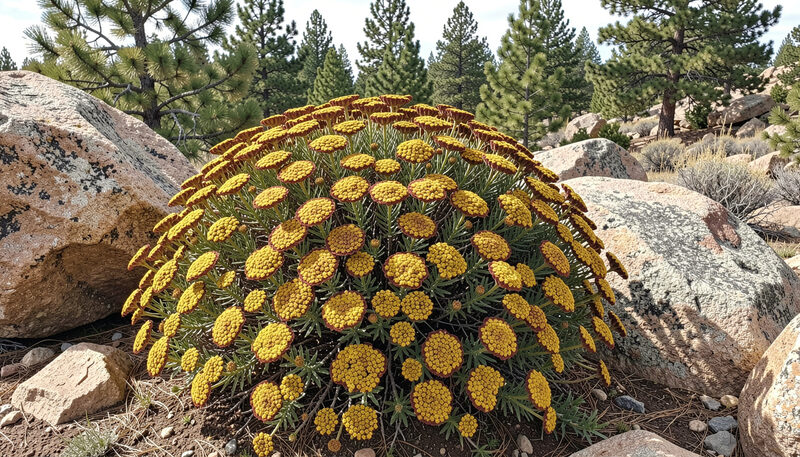
Sulfur buckwheat, Eriogonum umbellatum, is the buckwheat most western gardeners meet first, and the one many keep longest. In bloom it is a flat dome of chrome yellow held just above silvery foliage, and as the summer runs the yellow deepens to orange and rust from the outside of each head inward, so a single plant carries three colors at once. In the wild it wreathes montane slopes from the Sierra Nevada north to British Columbia and east to the Rockies, flowering in places where the soil is gravel, the rain stops in June, and the afternoon sun would cook a garden border.
The species is proof that a native plant can be both rugged and beautiful without breeding. It asks for sun, drainage and restraint from the hose, repays all three with a season of bloom that feeds the last butterflies of the year, and stays low enough for the smallest gravel garden.
What does sulfur buckwheat look like?
The plant grows as a mat forming subshrub, usually knee high or lower and wider than tall, its many stems rising from a woody base. The leaves gather mostly at the base, each a slender blade on a long stalk, green and faintly haired above and densely white felted beneath, so that wind flips the whole mat silver. The flowering stems carry small paired leaves and end in a compound head of many involucres, each cup holding several tiny yellow florets. After flowering the tepals persist and dry, holding the rust colors through autumn, which gives the plant a second season as structure in the garden. The general introduction to the genus explains how this cupped architecture works.
A variable species, read in varieties
No honest portrait of E. umbellatum can stay simple, because the species is one of the most variable plants in the western flora. Across its enormous range it varies in height, leaf shape, hairiness and the shade of its flowers, and botanists have described dozens of varieties to hold that variation. The old Eriogonum Society website, whose documents this domain once carried, once hosted photographs of the striking variety dichrocephalum among its plant pictures, and gardeners who grow plants from different mountain ranges quickly notice the differences. In practice this means seed or cuttings of known origin matter: a form from the high Sierra behaves differently in a hot valley garden than a form from the desert's edge. Nurseries that state collection origin are worth seeking for exactly this reason.
Where it grows wild
In the field the species follows dry, open, often rocky ground in the mountains: granitic flats, sagebrush edges, open pine forest and road cuts at mid elevations. It is a plant of the sunniest, fastest draining microsites, which is the single most useful fact a gardener can take from its wild address. The ability to read habitat this way is part of the routine taught in the field identification guide, and sulfur buckwheat, common and conspicuous, is a good species on which to practice it. Where it wreathes a slope, the drainage is sharp and the snow lies late, and both facts transfer directly to the garden.
How does it behave in a garden?
In cultivation the species asks for the conditions it left. Full sun, at least six hours of it. Soil of ordinary to poor fertility, with gravel worked in if the ground drains slowly, and a slight mound rather than a hollow. Planting in the cool months so roots can run before summer, following the method set out in the guide to planting a dry garden. Water deeply but rarely in the first summer, then progressively less, and give the crown a wide berth with the drip line. Overwatered plants go leggy and rot at the base; starved but well drained plants tighten into the dome that makes the species famous. A light shearing after the seed heads brown, never into bare old wood, keeps the mat compact for years, as the pruning guide details.
Why wildlife values it
Sulfur buckwheat flowers through the driest weeks, and in its mountains that makes it a lifeline. Native bees work the heads in numbers through August, and the plant serves as a host for buckwheat feeding butterflies whose caterpillars take the flowers and leaves, a role described in the guide to buckwheats for bees and butterflies. Left unpruned for a few weeks past bloom, the rust colored heads also feed seed eating birds before they shatter. A garden that wants pollinators through late summer could combine it with California buckwheat for a longer succession, one flowering early and long, the other holding the season's end.
The plant to buy is small, the hole is modest, and the place is the driest sunny slope in the garden. Everything else the species does on its own.