Field Guide · Notebook I
Identifying wild buckwheats in the field
A practical method for naming a wild buckwheat on a walk: read the involucre, count the flowers, feel the leaves, note the habitat, then reach for the flora.
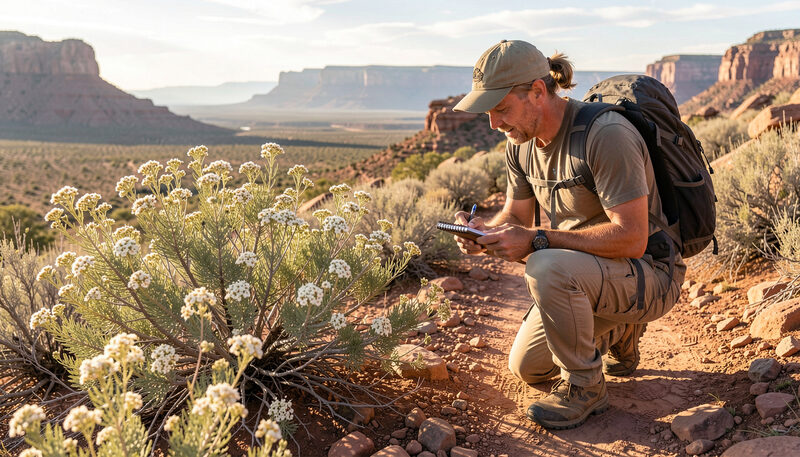
Identifying a wild buckwheat rewards a calm, ordered eye. The genus Eriogonum is large, and several of its species vary widely from hillside to hillside, so a walker who tries to jump straight to a species name usually lands in guesswork. This guide teaches the opposite: a fixed routine that reads the same few characters in the same order every time, settles the genus with certainty, and narrows the species list to a short set of candidates that a flora can finish. The method works as well in a garden as on a trail.
The routine rests on a simple fact: buckwheats announce themselves by architecture. Once the eye learns the involucre, the felted leaf and the head of minute flowers, the genus stops being anonymous, and the remaining question is only which of the local candidates stands in front of you.
What do you look at first: the involucre?
Start with the little cup. Each buckwheat flower sits inside an involucre, a small tube or bell of fused bracts that holds several florets, and the involucres then gather into heads or branching sprays. This two level architecture, florets inside cups, cups inside clusters, is the signature of the genus, and it survives the whole flowering season because the cups persist after the petals fall. Check three things on the involucre: its size relative to the head, its shape, whether it is turbinate, campanulate or cylindric, and its hairiness. In several groups, the involucre alone separates species, which is why collectors always take a head when they photograph.
How do you read the flowers?
Each floret is minute, and instead of petals it carries six tepals in two rings, usually white, cream, yellow or rose, often with a darker midrib that gives dried heads their streaked look. Count what you can without a lens: how many florets per involucre, whether the tepals are equal or in two unequal whorls, and how the color changes as the head ages. Age matters enormously in this genus. Sulfur buckwheat opens yellow and rusts red from the edge inward, while California buckwheat moves from pale pink to rust brown. A head photographed fresh can look like a different species from the same head six weeks later, so notes should always record the stage. The general account of the genus explains why these small flowers are built for tiny insects rather than show.
What do the leaves tell you?
Leaves come next, and they carry three questions of their own. Where are they: clustered at the base in a rosette, or scattered along the stems, or bundled in tight fascicles on short side shoots, the habit that gives California buckwheat its name? What is their shape and size, from the needle leaves of the desert shrubs to the broad blades of the island species? And what is their surface: green and hairless, white with a felt of tangled hairs, or waxy and grey? The felt is not decoration. It shades the leaf, stills the air across its surface and reflects light, all of which cut water loss, and it is often the character that separates a garden species from its wild lookalikes. Feel both faces with a fingertip and record which side carries the wool.
Where the plant grows narrows the list
Habitat is a character like any other, and in this genus it is often decisive. Note the elevation, the rock, the slope and the plant community: granite versus limestone, sagebrush versus chaparral, valley floor versus montane forest edge. Most buckwheats keep one address. Sulfur buckwheat follows montane granite, island lace follows sea bluffs, and the two never trade places. A species list for any western county runs long, but the short list for one granite slope at one elevation often holds two or three names, which is why the walk itself does half the identification. Regional floras, including the OregonFlora treatment, pair each species with exactly these addresses.
A calm field routine
Put the characters in order and the routine writes itself. Photograph or note the whole plant first, its shape and size. Then a single head, close enough to see the cups. Then one involucre opened if you collect, the leaves from both faces, the ground and rock, the neighbours, and the date. Read flowers before leaves, leaves before habitat, and habitat before anything written. A buckwheat noted this way can be named at home weeks later from almost any flora; a buckwheat photographed as a blur of cream cannot be named at all. The discipline takes five extra minutes on the trail and saves hours at the desk.
When the flora has to come out
Some groups resist the routine. The annuals key on seed coats visible only under magnification, several shrubby complexes intergrade where ranges meet, and the varieties of the widespread species grade into one another across hundreds of kilometres. This is not a failure of the method but a discovery about the genus: it is still being understood. The classifications that organize the difficulty descend largely from the work of James Reveal, the botanist who revised the genus, and a walker who reaches the hard end of a key is touching the same questions the professionals touch. When that happens, record the stand, photograph generously, and let the flora give the plant a name with a variety attached, or occasionally with an honest note that two names both fit.
The next walk is the place to start. Pick a familiar trail, apply the routine to the first three buckwheats met, and the fourth will almost name itself.