Field Guide · Notebook I
California buckwheat, Eriogonum fasciculatum
California buckwheat carries the chaparral year on pale heads that go from pink white to rust brown, feeds bees through the dry months, and asks only sun.
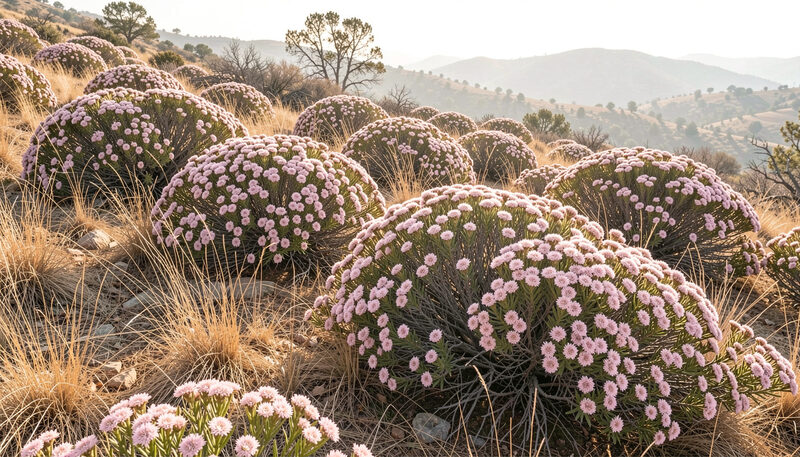
California buckwheat, Eriogonum fasciculatum, is the shrub that carries the chaparral. From the coastal scrub of the south to the inland slopes of the Peninsular ranges, it forms rounded grey bushes that flower for most of the year, feed the dry season's insects, and then hold their rust brown heads through winter as structure and seed. A gardener who wants to understand what a native California garden can be starts here, because this one species offers the whole argument: beauty without irrigation, season without lawn, wildlife without feeders.
It is also a window into how the genus works. The tiny flowers in their cups, the felted narrow leaves, the color shift from pale pink to rust, all repeat the genus habits explained in the introduction to wild buckwheats, but here at shrub scale and in the loudest possible habitat.
Recognizing California buckwheat
The species grows as a rounded shrub, typically waist high and somewhat wider, densely branched from a short trunk. Its leaves are the giveaway: small, narrow, and rolled under the edges, held in tight bundles called fascicles along the twigs, the trait that named the species. In the heat of summer the foliage can look almost black green, in the wet season bright and fresh, and always a little resinous to the smell after rain. The flower heads are round clusters of many involucres, each cup holding minute florets whose tepals open pale pink to white. The heads hold on the bush long after flowering, drying through shades of rose to a deep rust brown, so the shrub wears its autumn from late summer onward. Distinguishing it from other western shrubs is covered step by step in the field identification guide.
A shrub for all four seasons
Season by season, the plant keeps giving a garden something to look at. Late winter brings fresh foliage and the first tight heads. Spring opens the pale pink bloom, softening whole hillsides. In the dry months the flowers keep coming in flushes, and the heads darken head by head, so a single shrub carries every stage at once. Autumn and winter hold the brown heads, which catch low light and frost and structure the garden until the cycle restarts. Few shrubs of any origin offer eight months of change on no summer water, and the succession pairs well with the yellow domes of sulfur buckwheat in a mixed planting.
The backbone of chaparral
Ecologically the species is foundational. It is among the most abundant shrubs of southern California's coastal sage and chaparral, growing on dry slopes where it stabilizes soil, survives fire by resprouting and seeding, and offers nectar through the months when little else is in flower. That last role matters most. In the chaparral's long dry season, the buckwheats are a main nectar line for native insects, a fact developed in the guide to buckwheats for pollinators. Beekeepers in the region know the same fact from the honey side: California buckwheat yields a dark, robust honey that sells on its strength. A wild shrub that feeds native bees, honeybees, butterflies and then seed eating birds, on rainfall alone, is the definition of a keystone plant.
Growing it in a home garden
In gardens the species is agreeable to the point of ubiquity in mediterranean and desert landscaping, but it still has firm rules. Full sun. Excellent drainage, on a mound if the soil is heavy. Planting in the cool months, as with all chaparral plants, so roots establish before heat. Gravel mulch with the crown kept clear, and irrigation that is deep, rare and moved away from the base, following the schedule in the dry garden planting guide. The classic killer is summer water at the crown, which invites the root rots that chaparral plants never met in the wild. Given its rules, the shrub tolerates reflected heat from walls and paving, shears into rounded forms, and asks for renewal only after several years, a matter covered in the pruning guide.
Which butterflies depend on it?
Butterflies give the species its tightest bonds. The blue copper, a butterfly of the West whose caterpillars feed on buckwheat foliage, uses the genus across its range, and in the south west the Bernardino dotted blue is famously tied to California buckwheat, its caterpillars taking the flower heads, in some regions the very same shrubs generation after generation. A garden shrub that is a named address for a butterfly species carries a weight no exotic ornamental can claim. Gardeners who want that relationship in full plant the shrub in drifts rather than singly, leave some heads unpruned, and skip insecticides entirely.
Begin with one five gallon shrub on the driest sunny slope of the garden, plant it in November, and give it two winters of patience. The third year explains the species better than any article.